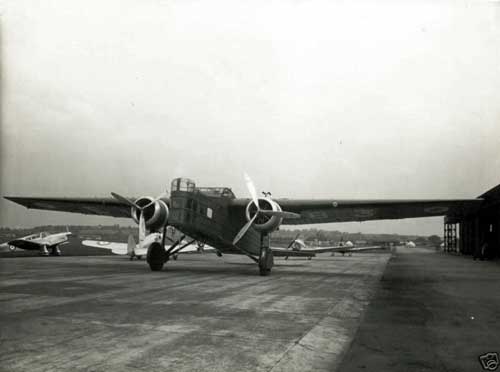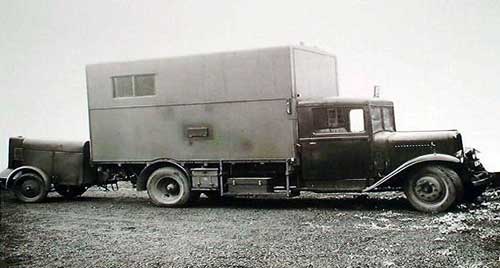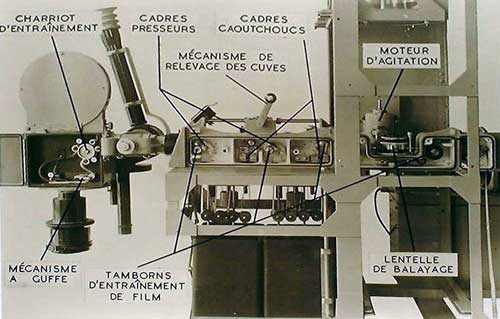

Early Electronic Television John Logie Baird Airborne TV System In the airplane: (operated by two men) camera and processing unit, scanner and viewing monitor, and radio transmitter. In the van on the ground: radio receiver, monitor panel and viewer, large picture reproducer, recorder on film, and projector. The range was 20 -25 miles. Height of the airplane was up to 10,000-15,000 feet depending on weather conditions. The equipment weighed 800 lbs and was being redesigned to 400 lbs complete for subsequent installations. The airplane contained a 16mm. camera with two lenses and a viewfinder for recording at different heights via a hole in the plane's floor. Thousand foot spool boxes were used with provision for twenty-five minutes of filming at 25 frames per second. The film then passed from the camera through two development tanks where the images were fixed, and then under a cathode ray tube where they were scanned and the impulses sent to a transmitter -- approximately a twenty second process. The ground receiving station was a van housing a photographic recorder, allowing either single pictures or a series of pictures to be recorded at will onto 35mm. film. The film was then processed and dried by machine, and projected onto a screen. This stage of the process required approximately three minutes. Baird's description of the system lists four principal advantages of this system: A permanent record is obtained of the film in the aircraft which may be taken down to the ground and studied in detail. Secondly, messages and diagrams may be transmitted to the ground at any time, in addition to information given by the film. Thirdly, the sensitivity of the system is much above that given by any electronic camera so that it can be used in much poorer light, (which also raises the possibility of infra-red photography). Finally, the system is capable of producing permanent records on the ground in less than five minutes after they have been transmitted from the air. There has been speculation that Baird was involved in official business with the Air Ministry during the 1920s and 1930s. He was almost certainly under a 'gag order' concerning his activities, and is said to have received £1000 a year from the Cable and Wireless Co. during World War II. Television broadcasting in Britain ended once war was declared in September 1939: The system was described in a handbook dated January 1940, when the war was already underway. However, the aircraft to ground television equipment was supplied to the French Air Ministry in July 1939, evidently in preparation for the declaration of war. The correspondence between Basil Brougham Austin and Ernest Moy Ltd. (who produced cinematographic cameras earlier in the century) in 1934 suggests that the project was being developed many years in advance of war, although it is by no means certain that Austin was corresponding about the same project. Also unclear is the nature of Baird's involvement with the develop system, due to the uncertainty of his own position at Baird Television at this time. It is not known whether the system was fitted in one aircraft or more. The July 1939 description mentions "redesigning" and "subsequent installations" to make the plane lighter, although the entire system would have been prohibitively expensive to build. However, the benefits of a reconnaissance plane that could produce permanent images on the ground were obviously of the highest importance at the start of the War. .
|