
Mechanical Television Columbus, Ohio Television Pioneer
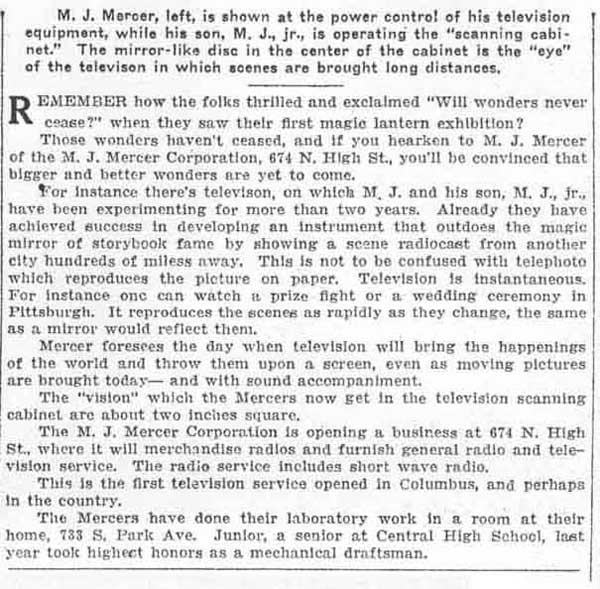
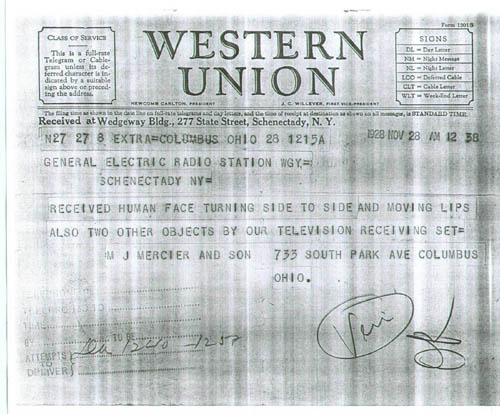
At Central High School Murry took extra courses in order to finish earlier. At one point he was told he was too young to operate the woodworking lathe in school. He then built his own lathe, using motors and other materials from his father's shop. During high school Murry spent a lot of time tinkering with electrical and mechanical devices with his father. At that time Murry Mercier Sr. began working at the B. F. Kerr furniture store on West Broad Street, running their radio sales and service department. The Merciers began to experiment with television, and built the first receivers in Columbus. One, with a 24 line disk, was used to receive broadcasts from WGY in Schenectady, New York. The other, which could receive both 45 and 60 line pictures, was used to receive broadcasts from KDKA in Pittsburg and W3XK in Silver Spring, Maryland (a suburb of Washington, D.C.). Murry remembered seeing a television program from WGY that was about 15 minutes long, consisting of block letters, probably "GE", from the upper left to the lower right of the screen. This was followed by a man's head turning from left to right. On November 28, 1928 the Merciers then sent a telegram to WGY, describing the program, and received letters for the station confirming that the Merciers had received the telecast. Neither set had any sort of synchronization, so the viewer had to constantly adjust ("drive", as Mr. Mercier describes it) the motor speed to keep the picture still. When Murry was in his senior year in high school, Murry Mercier Sr. opened a radio and television sales and service shop on North High Street. This was the first television service shop in Columbus, and maybe the first in the country. The newspaper article shown on the previous page gave him the publicity he needed to get started. Murry was spending a lot of time working at his father's shop, and finished high school early in the middle of his senior year. Soon the shop began to specialize in making mobile sound systems which were rented for special events. These sound systems were built on automobile bodies, and had large horn speakers. A separate six cylinder engine was added to power the generator for the electronic equipment. These systems were used at the Ohio State Fair and the Circleville Pumpkin Festival for years. Permanent sound systems were also sold and serviced by the Merciers, including one in Valleydale, a popular dance hall. At high school, Murry took a course in electricity, where he learned electronic theory. He soon learned how to build the transformers needed for the high power audio equipment. The amplifiers used by Mercier Amplifier Service had transformers built by Murry. Murry and his father operated the mobile sound service and sold Atwater Kent radios through World War Two. In 1948, the first television station in Ohio came on the air; WLWT in Cincinnati. Murry put a large antenna on the roof of the shop and was able to get a picture if conditions were right. He began to sell Teletone 7 inch sets. In 1949, stations came on the air in Columbus, and the shop became a dealer for a number of brands, including Crosley, Philco, RCA, and Zenith. The first bar in Columbus to have television was at the Jai Lai restaurant, where Murry put two Zenith 19 inch sets in custom made cabinets suspended from the ceiling. When the first color sets came out, Murry began to sell and service them. He remembers selling a few of the CT-100 15 inch sets. Here is a 1951 newspaper article about the Merciers. Murry also sold records for a time at the shop on North High Street. He also obtained a contract to maintain all the Hammond Organs sold in the state of Ohio. The shop continued to sell and service TV sets through the early 80s. Unfortunately, competition from the large discount houses made it impossible for Murry to continue in business. At one point, Murry recalls being able to buy a particular television set from Sun TV (the largest discount dealer) at a price lower than he could buy the set from the manufacturer. Finally, the decision was made to close the shop. Murry continued to repair television sets until the mid 90s, making house calls to many of his old customers. For several years he lived with his son and daughter in law in Columbus. He died in June of 2002 at the age of 90. |