
Early Electronic Television
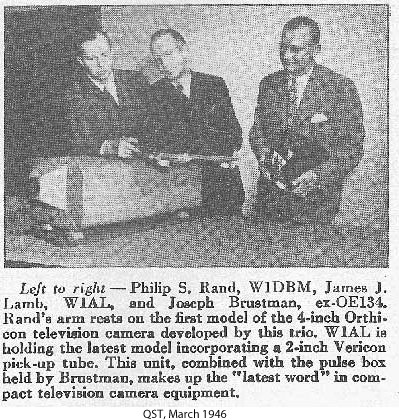
Remington Rand Orthicon CameraRemington Rand was involved in developing military cameras during World War Two, then manufactured industrial TV systems through about 1953. In 1950 they built a camera for the CBS field sequential system using an Image Orthicon. Reprinted from QST March 1946 in TELEVISION INTERFERENCE By Remington Rand Laboratory of Advanced Research (1953) Military Television Cameras-and the Amateur
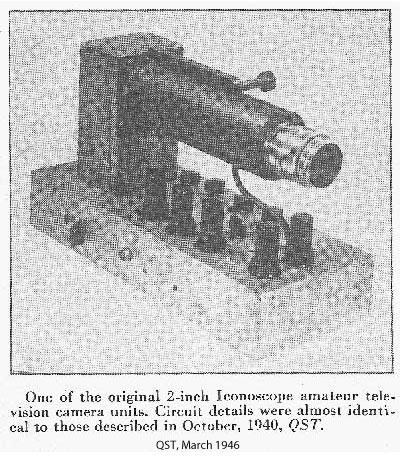
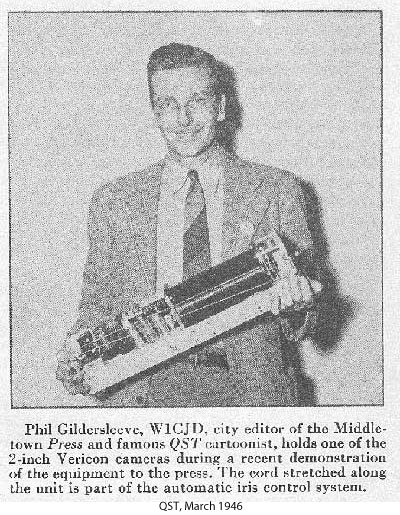
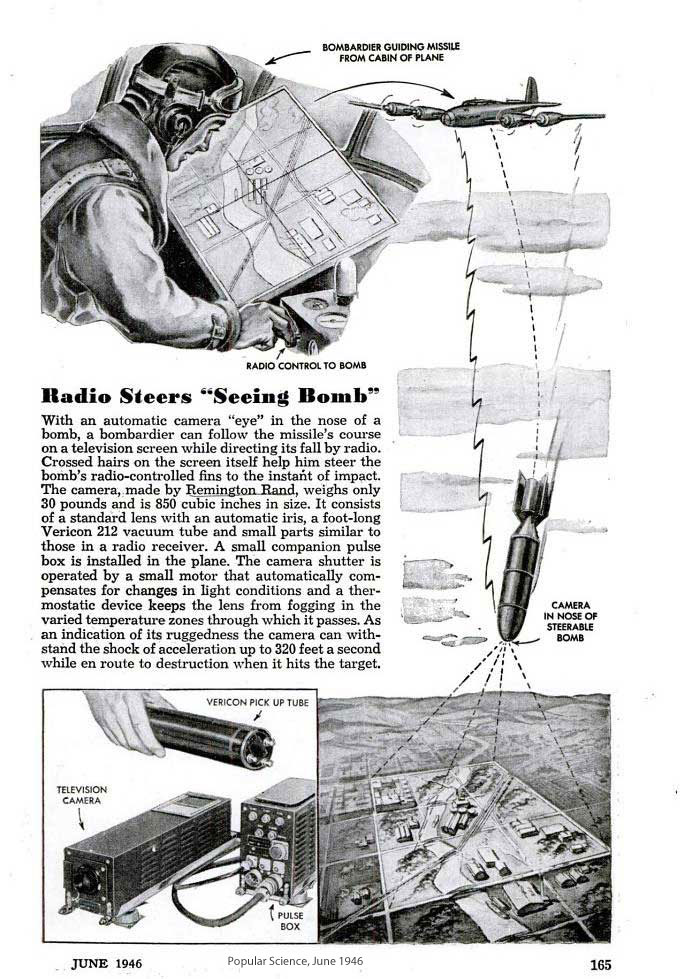
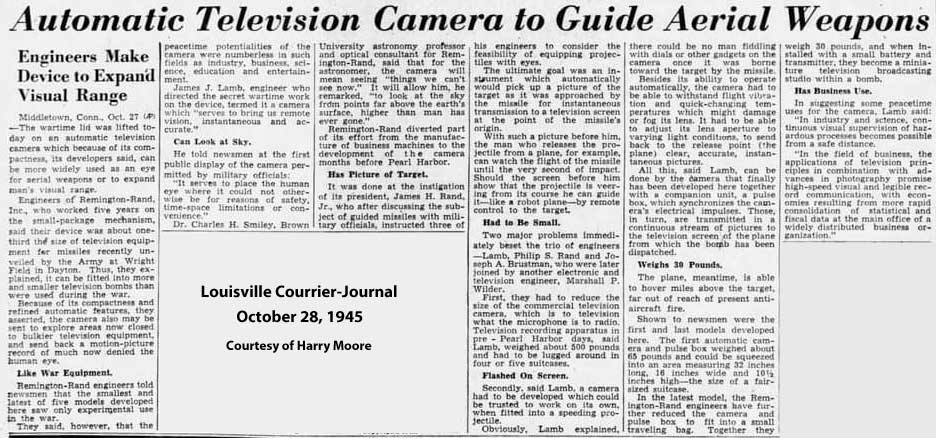
GUIDED-MISSILES have long been a dream of the fighting services. One obstacle in the path of their research was the lack of a suitable and effective "eye" in the controlled missile that could scan the scene and transmit this intelligence to the control operator who could then correct for any possible deviation in direction. Such an "eye" was finally supplied in the form of compact, light-weight, expendable television camera units which could be attached to or installed in a remotely-controlled missile such as a robot bomber, a glide bomb or a high-angle bomb. Two outstanding facts become evident in an analysis of the background of one such equipment. The first includes the inquisitiveness and ingenuity of the radio amateur that led him to delve into the mysteries of television. The second demonstrates the foresight and courage shown in QST's program to present amateur television in a manner designed to stimulate the radio amateur's activities along these lines. These two features combined to produce the type of compact, light-weight military missile-borne television camera equipment shown in the photographs. From the radio amateur's laboratories came the incentive. the original designs. applications and construction technique and radio amateurs initiated, nurtured, developed and carried through a program of research, development and production of television camera equipment in the Electronic Division of Remington Rand at Middletown, Conn. Among the first amateur television transmission experiments were those made by W1BCR, about 1932. This station transmitted television pictures on 160 meters utilizing a 48-hole scanning disc. These signals were received by various New England amateurs. including Philip S. Rand, W1DBM. Television transmissions were directed to definite stations and these stations answered back on 160-meter 'phone and described the character of the picture received. In those days it was considered an exceptional feat if the receiving station could identify and describe any details of the received images. Rand said recently, "I'll never forget the thrill when, at the end of a Falmouth Radio Club meeting at my shack, we tuned in on 160 meters for a few QSOs. Upon hearing the characteristic buzzsaw note I switched in the neon tube and after synchronizing the scanning disc we saw through a magnifying glass, my call, W1DBM, spelled out in big characters. W1BCR was 'calling' me by television! 1 answered on 160-meter 'phone and he replied by televising some Mickey Mouse cartoons in black and white. ,. In the latter part of August, 1940, while Rand was in Washington, he made inquiries on the possibility of controlling, by radio, bombs and other missiles so that they might be directed to their targets more accurately than with a bombsight. W1DBM had read Sherman's article in QST on a new electronic television transmitting system for the amateur and also Lamb's article on a new iconoscope for amateur television cameras. During a discussion with a naval officer concerning the possibility of guiding a bomb by radio remote control, Rand was told "that this would not be feasible due to the difficulty in seeing the falling bomb from a plane and hence the difficulty of estimating its probable striking point." This original opinion later proved incorrect. (The Army recently announced successful remote-controlled bombs known as the Azon and Razon. The difficulty in seeing bombs fall from the plane was overcome through the use of a smoke flare in the bomb.) As Rand sat there having his remote-controlled bomb idea picked to bits he recalled his amateur television interest and amateur television's recent publicity in QST. He countered that if a television camera could be built small enough to be put in the nose of the bomb then the bombardier would not have to worry about visually following the bomb in its fall but could see, on a television screen in his plane, the exact spot at which the bomb was hitting. Rand returned home, approached company officials, and was assigned the job of building an amateur television outfit to test the feasibility of building television cameras small enough to fit into a bomb. Due to the military secrecy surrounding such projects, Rand was unaware that research groups, having vast resources and engineering personnel, were also engaged in the development of television camera equipment for missile-borne use. In true amateur fashion Rand started on the project without the aid of outside sponsorship and satisfactory equipment was actually developed before any agency was sufficiently interested to offer any aid. A project had been started by H. J. Rand (W1DBM's nephew) utilizing' a two-inch amateur "ike" for picking up objects through fog and darkness by infrared rays. Experiments determined that the two-inch amateur "ike" was not particularly sensitive in the infrared region and therefore was of no value for this purpose and this equipment was made available and the television camera project got under way in September, 1940 with W1DBM and H. J. Rand as co-workers.
Tests disclosed that the two-inch amateur "ike" lacked sensitivity and definition for high quality pictures. This operating defect was brought home forcefully late one afternoon when demonstrating the equipment. There was insufficient light outdoors to get a decent pick-up. However, upon tuning in NBC's television they saw an excellent outdoor picture of a football game. Upon investigation it was learned that NBC was using an Orthicon type of pick-up tube. Samples of these tubes were procured and work started on a small camera utilizing this more sensitive pick-up. By now, the project had grown considerably and additional personnel was required. J. J. Lamb, W1AL, of QST, had been working on amateur television and was a logical choice. He was engaged on a consulting basis and later secured a leave of absence from the ARRL to devote full time to the project. Next came Joseph Brustman, ex-OEI34, a native of Vienna, Austria, a man with wide television experience. H. J. Rand dropped out to begin work on another project. Later he joined the. Army Air Forces. Toward the end of the war, with the rank of major, Rand actually controlled television guided missiles in the ETO. The first model utilizing a four-inch Orthicon was completed in the spring of 1941 and given vehicular tests transmitting back to the laboratory on 105 Mc. This camera unit weighed about 65 pounds as compared to the then existing "portable" commercial equipment comprised of six or seven large-size suitcases weighing a total of some 700 pounds. This midget television equipment was demonstrated to the armed forces but they did not appear particularly enthusiastic about such a "fantastic idea." However, the OSRD and the NDRC thought it worth while. They could not sponsor a completed project but if a smaller and lighter camera could be made it would be a new development which NDRC could sponsor. A new type of Orthicon pick-up tube had been experimentally made by Dr. H. B. DeVore of RCA, and this tube was used in a considerably smaller television camera subsequently developed for and demonstrated to the NDRC by the Middletown group. Early in 1942, Vernon Chambers, W1JEQ, obtained a leave of absence from QST and joined Rand and Lamb, as did Harry Whittemore, W1BR. By late spring it became apparent that more of the two-inch Orthicons would not be available from RCA, so it became necessary to manufacture them and Marshall P. Wilder, W2KJL, started the production of the desired pick-up tubes, assisted by Frank Norman, W1JZB. Daniel Smithwick, jr., W1NKA, went to work on construction of the cameras as did Calvin Bennett, W1KHL. August, 1943 brought George Grammer, W1DF (obtained on leave of absence from QST) and later Milton Bloomquist, ex W2BAI, joined Wilder's vacuum-tube section. John S. Muskatallo, W1BFW, and Thomas S. Pugarelli, ex-W2LWL, also were included in the project. Approximately fifty workers, men and women, were finally engaged in the manufacture and development of this equipment. The following information is from Mike Schultz: Some time back
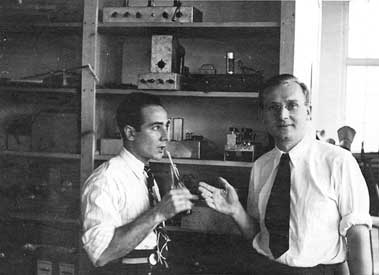
I found a group of old photographs at an auction which were from the
estate of Joseph Brustman, along with a small quantity of tubes.
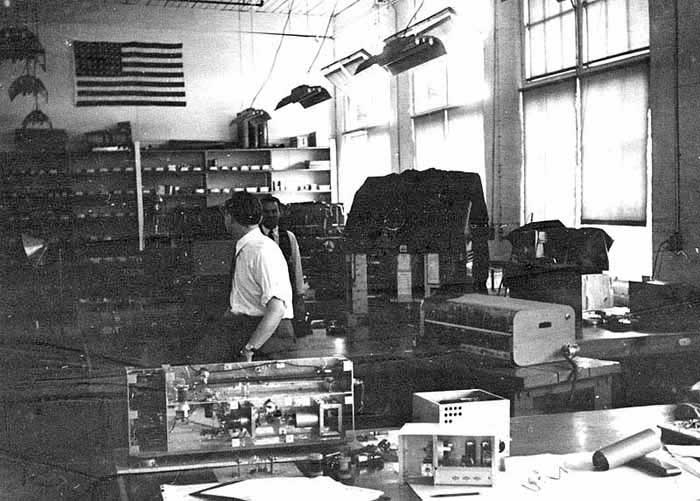
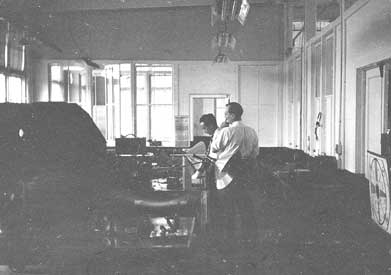
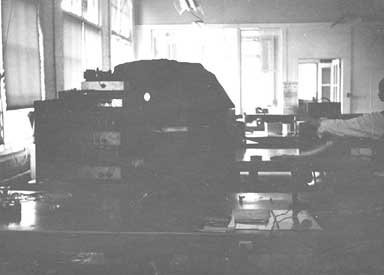
These photos show the test setup, probably for the 2-inch orthicon camera, with several chassis and who-knows-what under the black cloth. At the far right is a test pattern illuminated by two floodlights.
Automatic Television Camera to Guide Aerial Weapons
|