
Mechanical Television G5CV
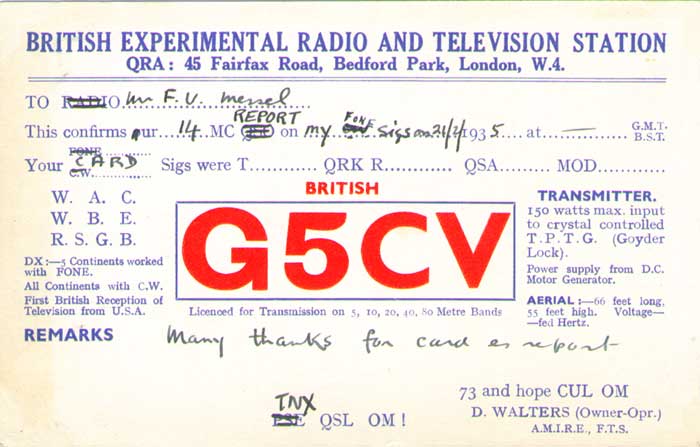
This card was from an amateur radio operator in England, and was sent to Forrest U. Messel, another amateur operator from Chillicothe, Ohio. The card claims that Douglas Walters (owner-operator of the British station), was the first to receive television broadcasting from the United States. The following is from UKSMG (United Kingdom Six Metre Group) Six News issue 72, February 2002:
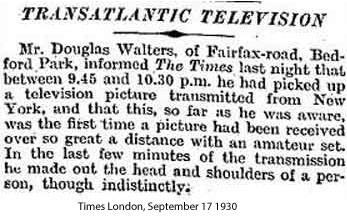
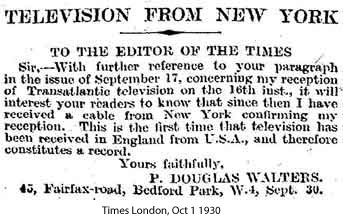
Since Mr. Walters was active in VHF radio experimentation, does this mean that the British reception of U. S. television was of electronic TV transmissions? If you have any information on G5CV or Douglas Walters, please contact us. The following are from Geoff Gilham. From the date of the newspaper articles, it is clear that it was mechanical television. The broadcast that Walters received was probably short wave, though it is possible that it was VHF, since RCA was experimenting with VHF in 1930. The only station that weI have documented as using short wave for television is General Electric is Schenectady. However, many people and companies were broadcasting TV on short waves using experimental or ham licenses. I suspect that he received either the GE Schenectady or RCA New York/New Jersey broadcasts, since these companies used relatively high power transmitters, and had extensive broadcasting schedules.
|