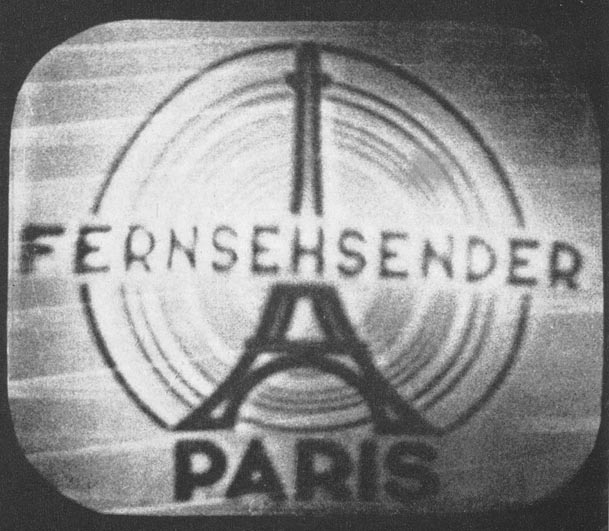

Early Electronic Television R.A.F. Reception of German TV from Paris In 1942 the Royal Air Force set up a receiving site on the coast of England to monitor TV transmissions from Paris. At that time Germany had invaded France and had taken over the the transmitter on the Eiffel tower and transmitted newsreels, and other programming for injured German soldiers in Paris area hospitals. It was rumored that the British Post Office installed a coaxial cable to transmit the pictures to London. Here is an article in 405 Alive that investigates that rumor. The following is from the book Adventure in Vision, the First 25 Years of Television, by John Swift: That incident is merely by the way. Another, which had an amazing sequel during the war, began the same year at the Devil's Dyke Hotel in Brighton. Kelsey had gone down there for a brief holiday-a busman's holiday because he took a television receiver with him. He was hoping to receive a signal from the Paris transmitter with its 985-foot aerial at the summit of the Eiffel Tower. He succeeded, and the London dailies duly recorded the fact.... Four years later, towards the end of 1942, British Intelligence sources were considerably puzzled by strange and unintelligible radio signals that had been reported. After investigation they established beyond doubt that some form of television waveform was originating from the Continent, and direction-finding tests pinpointed the source as Paris or a point in direct line between Paris and London. There was no clue as to what purpose the transmissions were serving. It was impossible, surely, that the Germans, short as they were of skilled men, had put the French television service into commission as an entertainment? This was all the more unlikely because very few receivers existed even when the French were running the service in 1939. It was possible that the enemy, falsely relying on the supposed security afforded by the limited range at which it is possible to resolve a picture-a very different problem from receiving and photographing a waveform-were using the service for some military purpose. There was no immediate answer to the problem. Intelligence HQ were aware of the television work of George Kelsey, then Wing-Commander Kelsey, of Headquarters, 60 Group, R.A.F. A signal was sent to 60 Group and, in Kelsey's own words, "I was frankly incredulous when I was detailed by my Group Captain [W. Proctor Wilson, now Deputy Chief of Research, BBC] to report to an underground Intelligence Headquarters in London for final briefing. Yet there could be no mistaking the waveform pictures that I was shown, still less was there room for doubt about the part that I was to play. The pictures were to be resolved at all costs and at top speed. Faced with the possibility that transmissions might end as abruptly as they had started, there was clearly no time to be lost. Any hope of designing and building a receiver was therefore out of the question. The only alternative was to try and borrow one-a curious requirement to have to explain away in the middle of a war when there was no television and when the real purpose was top secret." Kelsey made the trip to the EMI factory and there spun a plausible tale about special experiments with cathode-ray tubes and said please could he have some receivers-a couple would do nicely, thank you. His old colleagues were extremely helpful and before dusk two receivers were on their way to the South Coast. Kelsey took with him Squadron Leader Alfred Hunt, another BBC man with 60 Group, and at dawn work began on preparing a television reception site on the 570-foot-high cliffs of Beachy Head. Most of the day was taken up with aerial erection and receiver adjustment and there were occasional tip-and-run raiding Messerschmitts to liven up the proceedings. The interest displayed in the activities as the 109s streaked by at almost zero feet was a little disconcerting, but they committed no warlike act beyond the possible depressing of a camera shutter. The first test was a failure. In their endeavor to site themselves on the spot most favourable to reception from Paris this little R.A.F. group had posted themselves right in the centre of a heavy concentration of radar equipment of all kinds. The weak signals from Paris were completely blotted out. A start was made on a new aerial, one that would have done justice to a broadcasting station. It consisted of a curtain array of thirty-two normal television aerials slung between two 105-foot masts, and an elaborate reflector system which beamed the aerial on Paris and at the same time screened it from nearby interference. It was a masterpiece of design by Flight-Lieutenant S. F. Brownless, who was now returned to the more prosaic task of designing BBC television aerials. Kelsey tells how "in the blacked-out, smoke-laden atmosphere of our tiny hut we could hardly contain ourselves as the finishing touches were being put to the feeder system of our gigantic new aerial layout. Two more connections . . . one more connection ... a hasty re-check . . . then we switched on. In the sixty seconds or so that we had to wait for the cathode-ray tube to warm up, our eyes played the strangest tricks. We all thought we ' saw things' in turn. I have never disclosed what I thought I saw, but it certainly was not Paris. I took a liver pill when I went to bed that night. We were brought back to our senses by the appearance of a series of black lines moving diagonally across the screen. There was no mistaking this. A slight adjustment and suddenly the picture was there. It was a static picture of the Eiffel Tower with the words FERNSEHSENDER-PARIS superimposed. We learned later that it was the interval signal used by the Germans. The whole thing was unreal, fantastic. We were actually looking-in at the Germans in Paris!" The picture was not up to the standard that was obtained later, but it was photographed immediately. That is the picture facing page 112. For over two years the German vision service was monitored by the Intelligence Service and full details of what they saw and to what use they were able to put the information have never been disclosed. "Our job," Kelsey told me, "was merely to provide the picture, but in satisfying ourselves that reception conditions were stable, we stayed long enough to appreciate at least one valuable service that the enemy was unwittingly rendering. His newsreels depicting our bomb damage in France, with a commentary to whip up hatred of the British, provided a wonderful record at close quarters of the success of our efforts! " My general impression was that the enemy's object was to feed anti-British propaganda in a rather subtle way to a troublesome and restless population, relying upon the magic of television to hold audiences that otherwise could not be persuaded to go to the cinema. The programmes were not always straightforward, but my job was not Intelligence and beyond what, to me, was the obvious advantage of seeing close-up evidence of our bombing, I was content to leave the rest to the experts." If the Germans did succeed to any degree in fomenting anti-British feelings among the Parisians, which is doubtful, their success was far outweighed by its advantages to us in that it would have required almost suicidal reconnaissance crews flying at zero feet to obtain such " shots" of bomb damage in close-up. The pictures were ours for the watching for nearly two years. Kelsey's story sent me searching through the files, for I knew that [Edward R.] Murrow had included mention of television in his news report that night. I found this in the text of his broadcast on November 4: "... Paris is to-day a city of rumours. I encountered one rather more credible than the rest-and it turned out to be true. The story was that even during the German occupation one of the great arts of peace-television-had made surprising strides and, while television had more or less stood still in every other belligerent country, it had gone swiftly forward in France. I've not myself seen a demonstration of this development, but I have talked with reliable observers who have seen it in Paris, and I have had access to detailed though confidential reports. I don't know what the Germans have done with television, nor do I know what may be waiting to emerge from the laboratories in the Allied countries, but there has been developed in Paris television in which the picture is clearer and sharper than any that was being transmitted in America or Britain before the war. ... it is mildly encouraging to find evidence of progress in the midst of all the dying and destroying that is going on in Europe...." Another CBS correspondent, Charles Collingwood, was able to fill in some of the extraordinarily interesting details. He made a visit to the laboratories at Montrouge of the Compagnie des Compteurs, who had formed the subsidiary Compagnie Francaise de Television. There he found Rene Barthelemy, one of the early pioneers in France, in charge of all technical work. Collingwood, in a confidential written report to his New York office, described demonstrations he had seen. One of them-not of great importance-was of 450-line television projected on to a screen four feet by six, but the other was of 1050-line definition which from a distance of eight feet was "comparable" with the cinema. Barthelemy had apparently been working on 1,000-line television since 1940, and since hen the company had spent over ten million francs in research. More interesting still was what he found at the entirely separate and, until recently, German-controlled studios in Paris-in use up to August 16, 1944, a week before the liberation of the city. The Germans had, of course, smashed the Eiffel Tower transmitter before they left. Here are some of the notes as they appeared in the Collingwood memorandum: "A large studio has been built by the Germans with a control room for six cameras and an auditorium with seating for 250. . . .Three additional studios were being worked on-two small ones 30 feet by 15 feet, and one about 130 feet by 60 feet and 25 feet high.1 with a swimming pool in the centre. . .. "All equipment was of German manufacture, made by Fernseh A. G. The Germans removed the cameras but left behind the film apparatus. . . . "No one either at Compagnie des Compteurs or Radiodiffusion Francaise [the Paris studios] seems to have done any work with colour broadcasting, nor did they seem to think that colour television was very interesting." Much later reports from other sources showed that the Germans supervised the research at the Compagnie des Compteurs, while in Germany itself television was in operation until well into 1943, when the Berlin transmitter at Witzleben was bombed out of existence. It had been broadcasting a six-hour programme daily-one and a half hours of which was "live" studio material-for the entertainment of the wounded in hospitals. The German studios must have been the world's finest, for they housed no fewer than twenty-five cameras (Alexandra Palace has seven for studio use) and six cameras for films. In addition, there were two complete mobile units. Cable links relayed programmes also to several troop centres in the city for big-screen projection, including the Turmstrasse Cinema with seating for 800. Civilians rarely if ever saw television because all receivers were commandeered for service use. "All" does not mean very many. When production of receivers was stopped in 1940 only 600 or so of the standard or "people's" sets were in use and about a thousand others-a figure, by the way, demonstrating how far Germany lagged behind Britain up to the outbreak of war! The story of development research in Germany, its results and its significance are still only to be comprehended by the closest observer who is also an electronics expert, but there is enough evidence in the report of a British Intelligence investigation to show that the enemy used devilish ingenuity in the applications of television and associated radar. Very extensive work was carried out in applying television technique to war projects. Without going into technicalities, one Wellsian scheme was the fitting of a miniature television camera and radio link in the nose of a radio-controlled, pilotless aircraft which could be sent out on close-up reconnaissance work, reporting back what it "saw" to a receiving screen in the parent aircraft. Another application-a frightening one when you dwell on it-was the fitting of this miniature transmitting apparatus to an explosive-loaded aircraft or missile which could then be aimed with deadly accuracy as a television bomb. The target at which it was aimed by the parent aircraft would be seen closer and closer on the receiving screen as the pilotless thing flew nearer and would, in fact, continue to be seen in ever greater detail right up to the moment of impact! The German standard of 441-line definition was tried in this frightful experiment, but fortunately there was not sufficient time to put the weapon into operational use. That it did exist was proved in a laboratory demonstration to a group of our Intelligence scientists in 1946, when it was discovered that for experimental purposes semi-skilled women were producing three hundred miniature television tubes a month, two hundred of them satisfactory! The concern mainly engaged on this war project was that of Femseh and Blaupunkt, removed from Munich to Reichenberg, Czechoslovakia, to concentrate on war work. The amount of care that went into this television projectile device is further demonstrated by the fact that vertical scanning lines (as opposed to the horizontal lines we are accustomed to seeing) were used because the "subject" televised usually consisted of a horizontally divided area, half white, half dark-that is, the sky and sea or land divided by the horizon. Technically, the vertical lines were better for military purposes.
|